
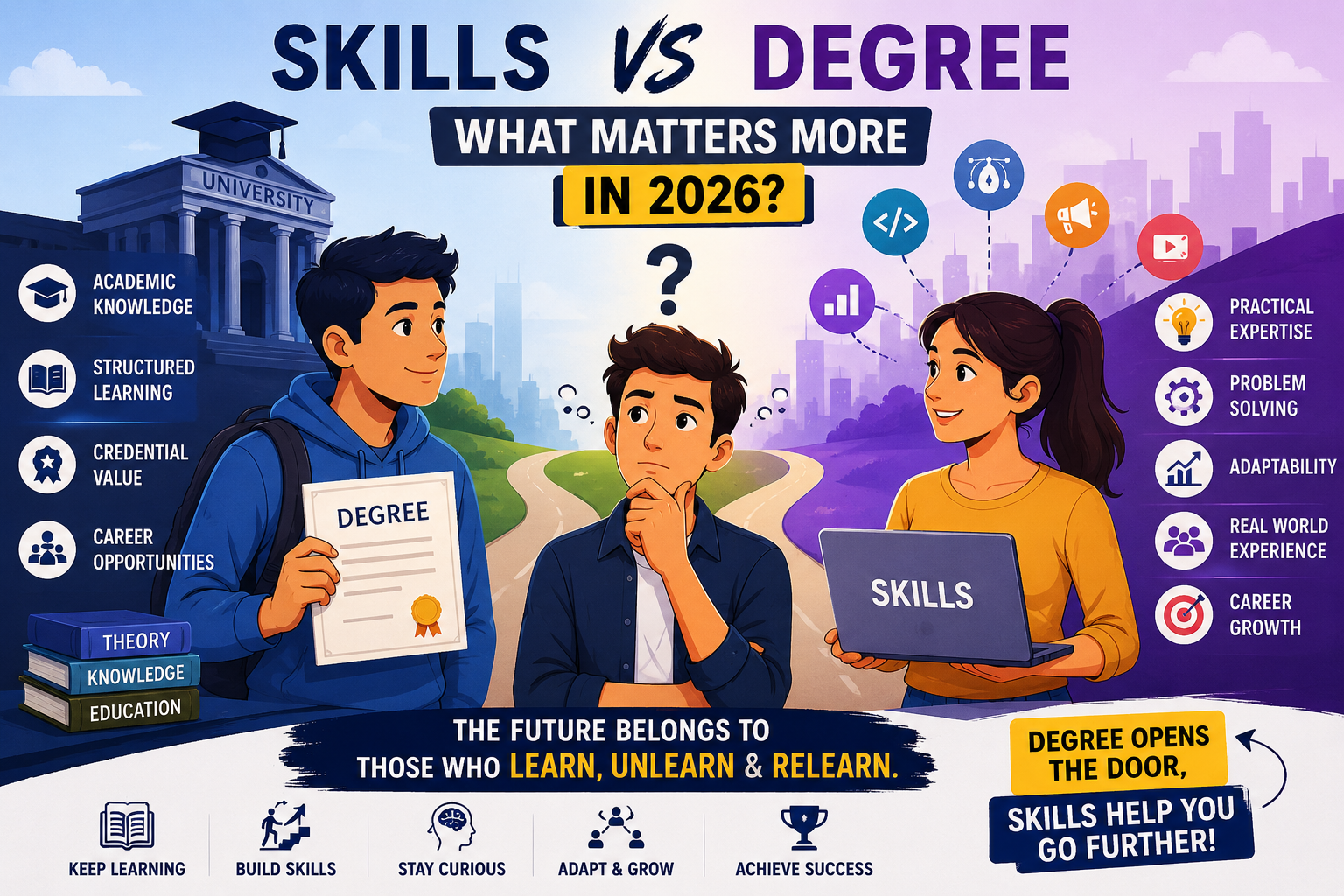
Can a college degree alone guarantee you a great job? Or are employers now looking beyond certificates and focusing on practical skills?
If you ask this question today, you’ll likely hear different opinions. Some believe a degree is the key to success, while others say skills are everything. The truth is, the workplace in 2026 has evolved, and so have employers’ expectations.
Today, companies are looking for people who can solve problems, adapt to change, and contribute from day one. While a degree still opens doors, skills often determine whether you walk through them.
Let’s explore why this debate matters and how you can prepare for a successful career in today’s competitive job market.
The Changing Face of Hiring
A decade ago, many companies filtered candidates primarily based on educational qualifications. Having a bachelor’s or master’s degree was often enough to secure an interview.
Fast forward to 2026, and things look very different.
Businesses now operate in a fast-changing environment driven by technology, automation, and innovation. Employers need professionals who can learn quickly, communicate effectively, and deliver results—not just people with impressive academic records.
This doesn’t mean degrees have lost their value. Instead, they are now considered one part of a much larger picture.
What Does a Degree Actually Offer?
A degree provides a strong academic foundation. It teaches discipline, theoretical knowledge, and structured learning.
It also serves as a basic eligibility criterion for many professions such as engineering, medicine, law, accounting, and government jobs.
A degree can help you:
For many careers, earning a degree is still essential.
Why Skills Are Becoming More Important
Imagine hiring two candidates.
The first has an excellent academic record but struggles to communicate, solve practical problems, or work in a team.
The second has average grades but confidently handles projects, communicates well, learns quickly, and adapts to new challenges.
Which one would you choose?
For many employers, the answer is obvious.
Skills demonstrate your ability to perform in real workplace situations. They show that you can contribute immediately without requiring extensive training.
In today’s hiring landscape, companies increasingly value people who can create results rather than simply showcase qualifications.
The Skills Employers Value Most in 2026
Regardless of your profession, certain skills have become highly desirable across industries.
Communication Skills
Whether you’re working in sales, HR, finance, IT, or customer support, effective communication builds trust, improves teamwork, and strengthens customer relationships.
Problem-Solving Ability
Every business faces challenges. Employers appreciate professionals who can think critically and find practical solutions.
Digital Skills
Technology has become part of nearly every job role. Familiarity with tools like Microsoft Excel, CRM software, AI-powered applications, and collaboration platforms gives candidates a competitive advantage.
Adaptability
Industries continue to evolve rapidly. Professionals who embrace change and continuously learn new skills remain valuable throughout their careers.
Leadership and Teamwork
Companies look for individuals who can collaborate effectively while also taking ownership of responsibilities when needed.
Time Management
Meeting deadlines and managing priorities efficiently can significantly improve workplace performance.
Industries Where Skills Matter More Than Degrees
Many sectors now prioritize practical expertise over academic qualifications.
Examples include:
In these fields, employers often evaluate your portfolio, projects, certifications, and practical experience alongside your education.
When Does a Degree Matter More?
There are still professions where a degree remains non-negotiable.
Examples include:
In such careers, academic qualifications are legally or professionally required before entering the workforce.
Why the Best Candidates Have Both
The discussion shouldn’t really be Skills vs Degree.
Instead, it should be Skills + Degree.
Think of your degree as the key that unlocks opportunities and your skills as the engine that drives your career forward.
A candidate with the right education and strong practical abilities is often the first choice for employers.
How You Can Build Job-Ready Skills
Fortunately, developing new skills has never been easier.
You can:
Remember, learning doesn’t stop after graduation—it continues throughout your career.
The Future Belongs to Lifelong Learners
The biggest advantage you can have in 2026 isn’t just a prestigious degree or a long list of technical skills.
It’s the willingness to keep learning.
Technology, industries, and customer expectations will continue to change. Professionals who continuously upgrade themselves will always stay ahead of the competition.
Employers value curiosity, adaptability, and a growth mindset just as much as qualifications.
Final Thoughts
So, what matters more in 2026—skills or a degree?
The honest answer is both, but they serve different purposes.
A degree helps you get noticed.
Skills help you get hired.
And your attitude, willingness to learn, and ability to adapt determine how far your career will go.
Instead of choosing one over the other, invest in both. Build your knowledge through education while continuously improving your practical skills. That’s the combination that will help you stand out in today’s competitive job market.
Whether you’re a fresher starting your career or a professional looking for your next opportunity, remember this:
Your degree may open the first door, but your skills will open every door after that.
Frequently Asked Questions (FAQs)
1. Are degrees still important in 2026?
Yes. Degrees remain important in many professions and are often the minimum qualification employers require. However, practical skills are becoming equally important.
2. Can I get a good job without a degree?
Yes, in fields such as digital marketing, sales, customer support, content writing, graphic design, software development, and many technology-related roles. However, some professions still require formal education.
3. Which skills are most in demand in 2026?
Communication, digital literacy, problem-solving, AI awareness, leadership, adaptability, teamwork, and time management are among the most sought-after skills.
4. Do employers value certifications?
Yes. Industry-recognized certifications demonstrate your commitment to learning and can strengthen your resume, especially when combined with practical experience.
5. What should freshers focus on?
Freshers should build technical knowledge while also improving communication, presentation, teamwork, and practical experience through internships, projects, or freelance work.
6. Which industries prioritize skills over degrees?
Industries such as digital marketing, IT, recruitment, customer service, sales, e-commerce, and startups often place significant emphasis on practical skills and experience.
7. How can I improve my skills while studying?
You can enroll in online courses, complete internships, work on personal projects, participate in competitions, volunteer, and regularly practice communication and problem-solving.
8. What is the biggest career advice for students in 2026?
Don’t stop at earning a degree. Keep learning, develop practical skills, stay updated with industry trends, and be open to change. Continuous learning is one of the strongest predictors of long-term career success.


