

Introduction
Recruitment has always focused on connecting the right people with the right opportunities. Over the years, hiring practices have changed significantly, moving from newspaper ads and walk-in interviews to online job portals and virtual hiring processes. Today, another major shift is occurring with the rise of artificial intelligence (AI).
Companies are increasingly using AI tools to simplify hiring and cut costs. Meanwhile, human recruiters still play a vital role in forming relationships and making informed decisions.
This leads to an important question: Will AI replace human recruiters, or will both collaborate to shape the future of recruitment?
The answer is more complex than simply technology or human skills. The future will likely combine both elements.
In this blog, we will look at how AI is changing recruitment, where human recruiters continue to shine, and what the future of hiring might hold in the coming years.
The Evolution of Recruitment
Recruitment has changed dramatically over the last decade. In the past, recruiters spent countless hours reviewing resumes, scheduling interviews, and manually tracking candidate information.
Today, technology has automated many of these tasks. Job portals, applicant tracking systems, video interviews, and AI screening tools have made hiring faster and more efficient.
As organizations receive hundreds or even thousands of applications for a single role, businesses are increasingly using AI to handle large amounts of candidate data and quickly identify suitable applicants.
What Is AI Recruitment?
AI recruitment involves using artificial intelligence and machine learning technologies to assist with various stages of the hiring process.
These tools can:
Instead of spending hours manually reviewing applications, recruiters can rely on AI to find the most relevant candidates in minutes.
How AI Is Transforming Recruitment
1. Faster Resume Screening
One of the most time-consuming tasks for recruiters is reviewing resumes.
AI systems can scan thousands of applications in seconds and shortlist candidates based on criteria like skills, education, certifications, and experience.
This dramatically reduces the time required to find qualified candidates.
2. Improved Candidate Matching
Modern AI tools can analyze job descriptions and compare them to candidate profiles to identify the best matches.
This helps recruiters focus on candidates most likely to succeed in a specific role.
3. Enhanced Candidate Experience
Many organizations now use AI chatbots to answer candidate questions, provide updates, and guide applicants through the recruitment process.
This ensures candidates receive timely responses instead of waiting days for updates.
4. Reduced Administrative Work
Scheduling interviews, sending reminders, and maintaining recruitment records can take up valuable recruiter time.
AI automates many of these routine tasks, allowing recruiters to focus on more strategic hiring activities.
5. Data-Driven Decision Making
AI can identify hiring trends, predict workforce needs, and provide insights that help organizations make informed hiring decisions.
Companies can use this data to improve hiring outcomes and workforce planning.
Where Human Recruiters Still Have the Advantage
While AI has impressive capabilities, recruitment is ultimately about people. Human recruiters offer qualities that technology cannot fully replicate.
1. Understanding Human Behavior
A resume cannot reveal everything about a candidate.
Experienced recruiters evaluate:
These factors often determine whether a candidate will succeed within an organization.
2. Building Relationships
Recruitment is not just a transaction; it is a relationship-driven process.
Candidates often have concerns about:
Human recruiters can build trust, address concerns, and offer personalized guidance throughout the hiring journey.
3. Assessing Cultural Fit
Even highly skilled candidates may struggle if they do not align with an organization’s culture and values.
Human recruiters can notice subtle behavioral cues and interpersonal skills that AI might overlook.
This helps companies find individuals who fit both the role and the organization.
4. Handling Complex Hiring Situations
Not every hiring decision follows a standard process.
Human recruiters can manage the following:
These situations often require judgment, empathy, and flexibility that technology cannot fully provide.
5. Providing a Human Touch
Changing jobs is one of the most important decisions in a person’s career.
Candidates appreciate talking to someone who understands their goals, listens to their concerns, and offers meaningful advice.
Human interaction remains a crucial part of the recruitment experience.
Will AI Replace Recruiters?
This is one of the most common questions in the recruitment industry.
The simple answer is no.
AI will take over repetitive recruitment tasks, but it is unlikely to completely replace recruiters.
Instead, AI will serve as a powerful assistant that helps recruiters work more efficiently.
Recruiters who embrace technology will gain a significant advantage. They can spend less time on administrative tasks and more time engaging with candidates and clients.
The future is not AI against recruiters; it is AI supporting recruiters.
The Future: Human Recruiters Working Alongside AI
The most successful recruitment organizations are already combining technology with human expertise.
In the future, recruitment may look like this:
AI Handles:
Human Recruiters Handle:
This partnership allows companies to achieve both efficiency and quality in their hiring process.
Skills Recruiters Need for the Future
As technology continues to change, recruiters must also develop new skills.
Important skills for future recruiters include:
Recruiters who blend human expertise with technological knowledge will remain valuable in the job market.
What This Evolution Means for Job Seekers
Job seekers should also recognize how recruitment is evolving.
To boost their chances of getting hired:
Candidates who understand both AI screening processes and human interview expectations will have a competitive edge.
Conclusion
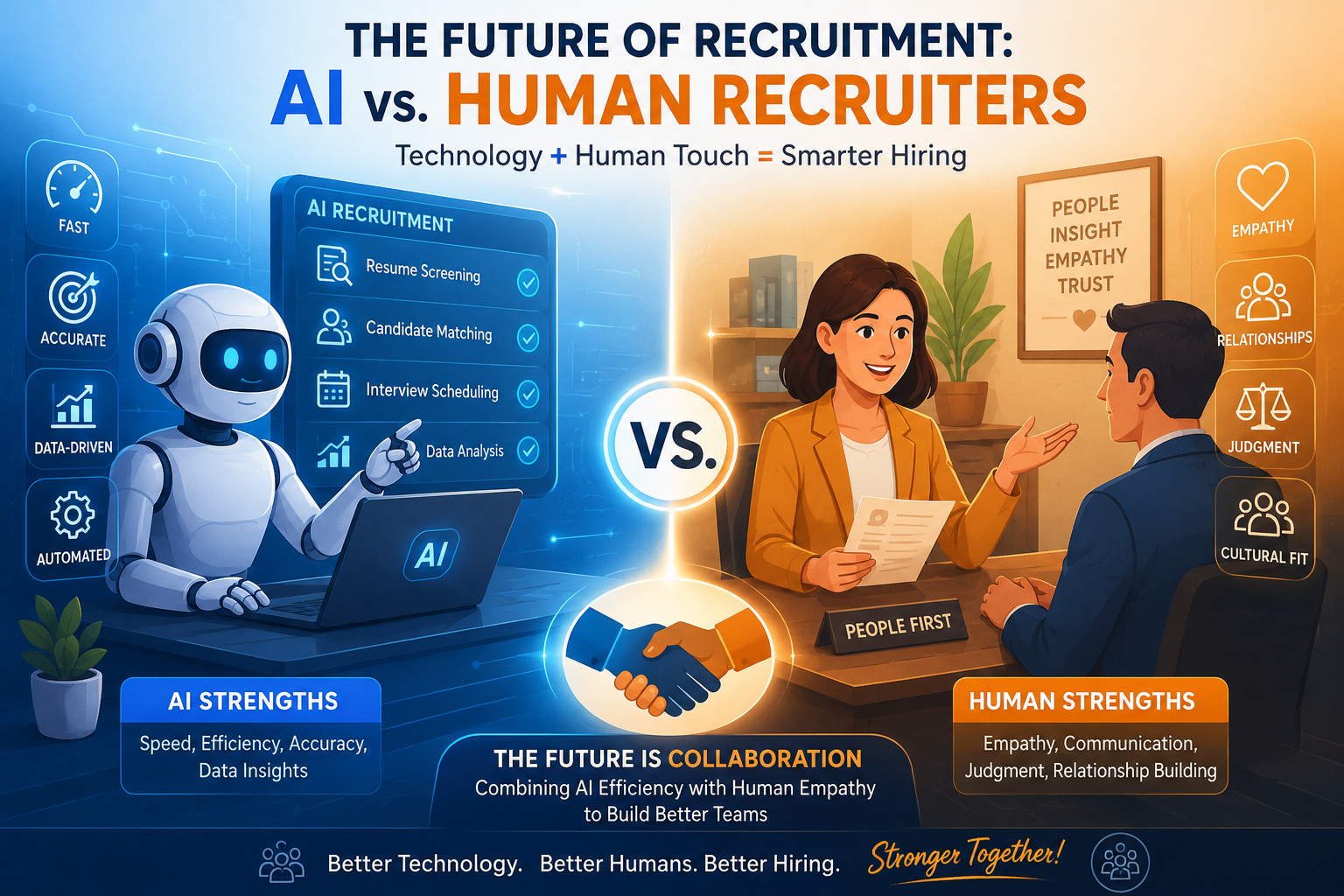
The future of recruitment is not a clash between artificial intelligence and human recruiters. Instead, it is a partnership that merges the efficiency of technology with the emotional intelligence and judgment of people.
AI can process large amounts of data, automate repetitive tasks, and enhance hiring efficiency. However, human recruiters bring empathy, relationship-building skills, intuition, and strategic thinking that are essential in hiring decisions.
As recruitment continues to change, organizations that effectively balance technology and human expertise will draw the best talent and achieve stronger hiring outcomes.
The future belongs not just to AI or human recruiters, but to those who learn to harness the strengths of both.
Frequently Asked Questions (FAQs)
1. Can AI completely replace human recruiters?
No. AI can automate repetitive tasks, but human recruiters are still vital for building relationships, assessing candidates, negotiating, and making strategic hiring decisions.
2. How does AI help in recruitment?
AI assists by screening resumes, matching candidates to jobs, scheduling interviews, analyzing recruitment data, and reducing administrative workloads.
3. What are the advantages of human recruiters over AI?
Human recruiters offer emotional intelligence, communication skills, cultural fit assessments, relationship building, and personalized support for candidates.
4. Is AI recruitment more accurate than human screening?
AI can enhance efficiency and consistency, but human judgment is necessary to evaluate soft skills, motivation, and cultural fit.
5. What skills should recruiters develop for the future?
Recruiters should focus on communication, relationship management, strategic thinking, technology adoption, employer branding, and data analysis.
6. How can job seekers prepare for AI-driven recruitment?
Candidates should optimize their resumes with relevant keywords, maintain updated profiles, showcase achievements, and strengthen their interview skills.
7. Will AI make hiring faster?
Yes. AI significantly cuts down the time spent on resume screening, candidate matching, scheduling, and administrative tasks.
8. What is the future of recruitment?
The future of recruitment will involve collaboration between AI and human recruiters, combining efficiency, data-driven insights, and human judgment to achieve better hiring results.


